


Better questions make for better B2B marketing
Before any work starts, the most valuable contribution a B2B marketer can make is to ask a better question.
In my experience, far too many marketing conversations start with tactics: more posts, more reach, more followers. Those are signs of activity, and they do very little to help a business make a better decision.
In B2B, that matters even more. The insight a marketer needs sits in many places: sales conversations, customer success, product, finance and senior leadership. It is rare to have all of it at the start of any piece of work, and asking questions is how you gather it.
Start with strategy
Brandwatch’s 2026 research found that only 25% of marketers say they understand their audience very well. That matters, because good strategy depends on it. Objectives, positioning, messaging and channel choices all rest on knowing who you are trying to reach and what they need from you. Without that understanding, a team can agree a plan quickly and still be building on assumptions. The foundations come first: who the work is for, what success looks like and what it is meant to change.
However, there is good reason teams skip ahead to tactics. NIQ found that 74% of CMOs are under more scrutiny to prove marketing ROI, while dealing with fragmented data, leaner teams and a growing pull towards short-term conversion. According to Gartner, budgets are flat at 7.7% of company revenue, and 59% of CMOs report they do not have enough to execute their strategy. Every line of spend gets examined. That pressure often gets translated into tactics, and the team ends up working hard without getting closer to the commercial answer the business wanted in the first place.
Peter Drucker, the management thinker and author, warned that the most serious mistakes come from asking the wrong question, not from giving the wrong answer. A good answer to the wrong question is rarely challenged, because the work gets started, looks professional and nobody stops to ask whether it was the right work in the first place.
The way through is better questions. They sharpen the objective, improve the work before it is created and make reporting more useful. They also give marketers a way to push back, politely and intelligently, when the ask is not yet clear enough.
Questions are a commercial tool
I often talk about topics like this with Katy Howell, Partner at Rethink Social. When you work alone, a good sounding board and confidante matters; you need someone to share the challenges of working in marketing with. Earlier this year we explored the subject of “better questions, better marketing” and took our thoughts to a LinkedIn Live.
Katy’s view is that questions are a commercial tool, not just a soft skill. They shape what gets prioritised, measured, challenged and waved through, and they decide whether marketing is supporting business goals or simply keeping the feed warm.
In my consultancy work, I take the same approach to any request. My starting point is: tell me what the problem is, and then let me help diagnose the root. Katy’s take is that this shifts the marketer’s role, so you are helping the business think rather than simply producing what was requested as fast as possible.
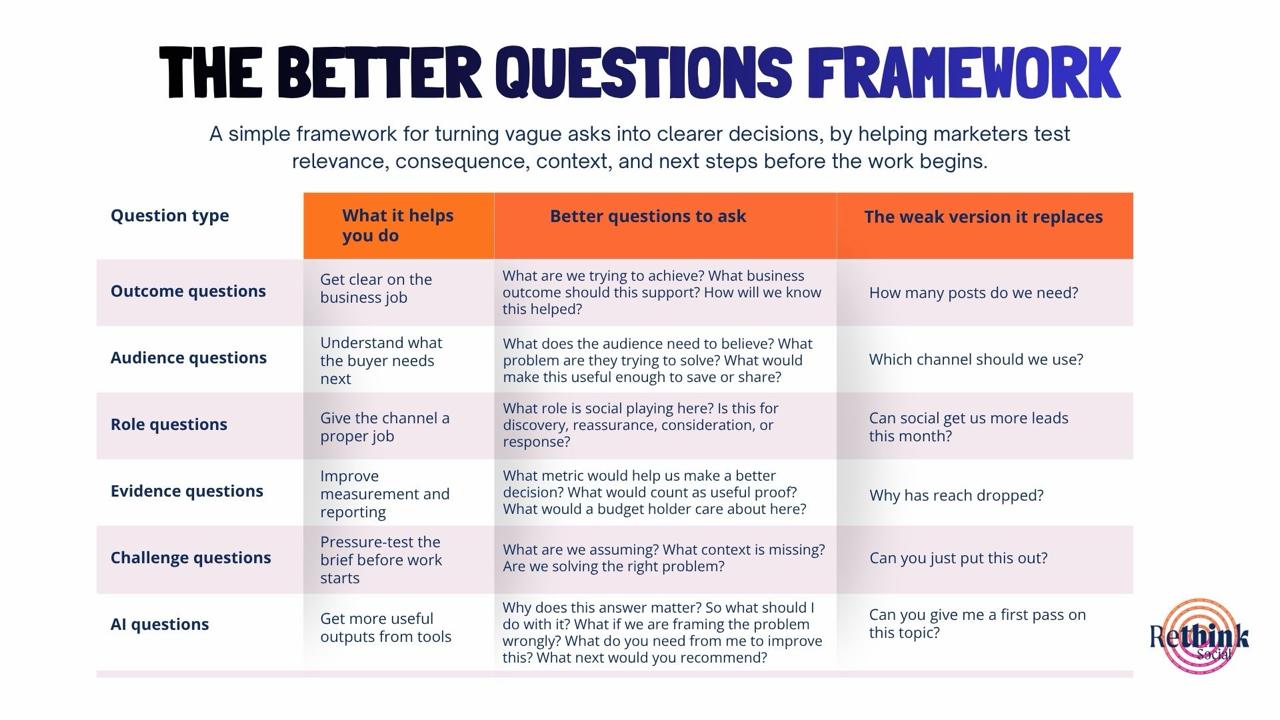
A simple way to make this practical is to sort your questions by what they are there to do. Here is Katy’s Better Questions Framework, which I highly recommend:
Better questions make AI more useful
AI is part of most marketing conversations now, and it is a good test of the argument in this post. AI can save time, help with data analysis, support planning and lighten the mechanics of the work. It cannot fix the thinking that goes into it. A vague idea does not become clearer because AI helped it arrive faster, and an unclear objective does not become strategic because it was turned into a slide.
AI responds to the quality of your question and the context you give it. With good context, it helps you think further. Without it, you get something plausible and generic. So the discipline is the same one this post is about: ask the better question first.
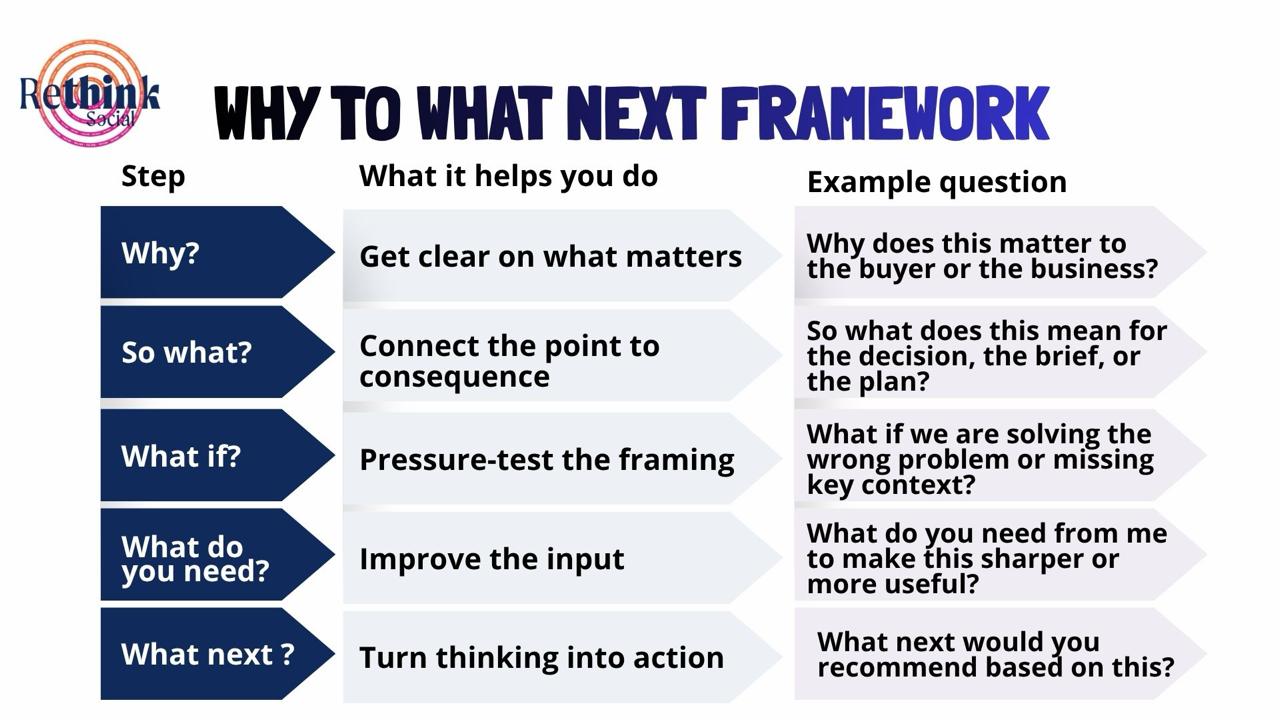
This is where Katy’s Why to What Next sequence is also useful. It works for planning, reporting and AI prompts:
Why helps you get clear on what matters. Why does this answer matter?
So what connects the answer to consequence. So what should I do with it?
What if tests whether you are framing the problem well. What if we are framing the problem wrongly?
What do you need improves the input. What do you need from me to improve this?
What next turns the thinking into a decision. What next would you recommend based on this?
Asking questions is part of the B2B marketer’s job
Better questions only help if people feel able to ask them, and many don’t.
Asking a question is not a sign that you don’t know what you’re doing. We all need to ask questions, however experienced we are, because effective marketing depends on them at every level.
Yet a lot of marketers hold back, especially those newer to the profession. When you’re starting out, a question can feel risky. It might make you look as if you haven’t understood the request. It might seem to slow things down when everyone is busy. It might feel like challenging someone more senior, particularly when the ask comes from a director or a different department. So the easier option is to nod, take the request as it stands, and get on with the output.
The gaps don’t go away. They show up later, in rounds of amends, in reporting nobody can use, or in content that was never quite right for the audience.
There is research behind why this happens. Amy Edmondson at Harvard Business School describes psychological safety as a shared belief that a team is safe for interpersonal risk-taking, and asking a question in front of more senior colleagues is exactly that kind of risk. Google’s Project Aristotle, a study of what makes its teams effective, found psychological safety was the most important of the five factors it identified.
If you’re newer to marketing, frame your questions around wanting to get the work right:
So I get this right, what is this meant to achieve for the business?
Which part of the buying group is this for, and what do we want them to do next?
Where does this sit in the buying journey, and what does sales need from it?
How will we know it has worked?
Asked that way, questions come across as professionalism, not doubt.
If you lead a team, make asking feel normal. Ask questions yourself, out loud, including the ones that feel basic. Thank people when they challenge an assumption. When a junior team member asks “why are we doing this?”, treat it as a sign they are thinking commercially.
Better questions rarely add work. They remove waste: the unclear objective, the content that misses the audience, the reporting that turns into admin.
In practice, the change starts small.
Pause.
Ask a better question.
Then start.
And if you’re the one in the room who isn’t sure whether to ask: ask. It’s how we all get better. That is a much better place to begin than another debate about the best time to post.

About the author
Luan WiseAI, Social Media, Customer behaviour
Luan Wise is a seasoned marketing practitioner with 25 years of experience across agency, client-side, and consultancy roles, working with both B2B and B2C organisations, large and small. She is a chartered marketer and Fellow of the Chartered Institute of Marketing (FCIM) and is currently pursuing a PhD by Portfolio at the University of Lancashire. Alongside her consultancy work, Luan delivers industry talks and training workshops for professional bodies, university business schools, and organisations worldwide, including LinkedIn, Meta, and Google. Luan is the prolific author of eight books, including The Future of B2B Marketing: Harnessing AI to Unlock Smarter Decisions, Relax! It’s Only Social Media, Planning for Success: A Practical Guide to Setting and Achieving Your Social Media Marketing Goals..
Keep reading
Related articles
Take it further