


The longevity of a good idea
I suspect most people reading this won't recognise the names Jock Kinneir and Margaret Calvert. And yet, if you're reading this in the UK, you've probably relied on their work several times today. You may even be relying on it right now (although legally you shouldn’t be reading this if so!)
Kinneir and Calvert designed the Transport and Motorway typefaces and the wider system of road signage that we still use today. Their work began in the late 1950s and continued through the 1960s, when Britain's rapidly expanding road network needed a clearer, more consistent way of communicating with drivers. They thought about how quickly we needed to recognise information, how we read words at speed, how colour and contrast affect legibility, and how to make signs work in the real world rather than simply look good on a designer's drawing board. Their work has influenced road signage well beyond the UK, too. From Ireland to Iceland, Italy to Indonesia and beyond.
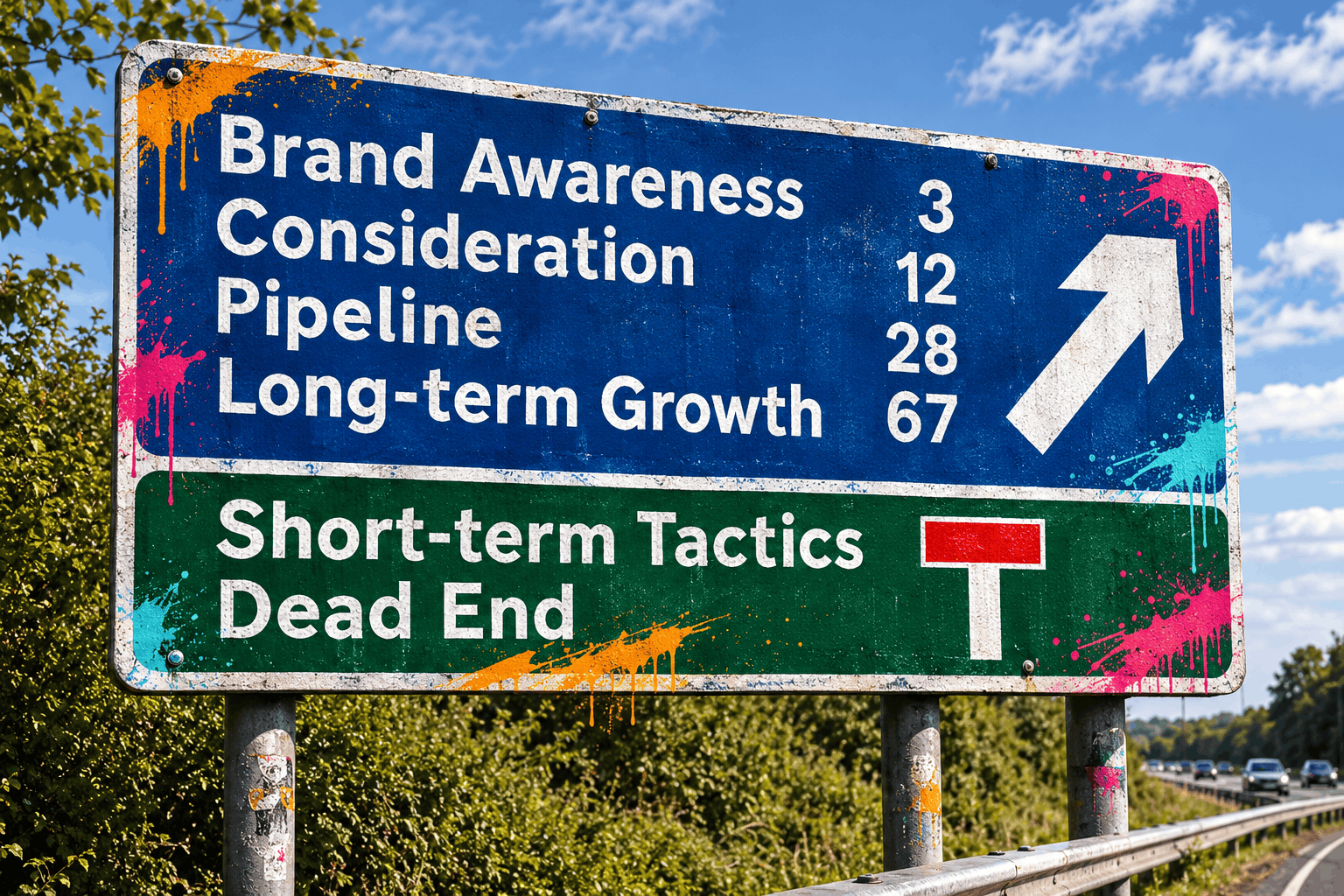
Think about that for a moment. Something created more than sixty years ago still helps millions of people navigate their way around the country every day, without most of them giving it a second thought. That's quite an achievement for a couple of designers whose names are probably unfamiliar to the majority of us.
I was reminded of this when driving in Dubai a few years ago. I found some of the road signs surprisingly difficult to read and interpret, particularly in bright daylight, when the combination of lettering, colours and contrast seemed to make finding the information I needed rather harder than it should have been. Perhaps I was unfamiliar with the local system, and I wouldn't pretend to have conducted a rigorous assessment of road-sign design in the UAE. But it made me appreciate just how much thought goes into a system that, when it works well, we barely notice.
And it got me thinking about the lifespan of good work, and how differently we seem to treat it in marketing.
In particular, B2B marketing.
We live in a world of always-on paid media, quarterly targets, campaign dashboards and an almost immediate expectation that we should be able to demonstrate results. We launch something, watch the numbers, optimise it, report on it and then, all too often, move on to the next thing. The next campaign. The next theme. The next big idea.
This is particularly noticeable in technology companies, where the start of a new financial year can bring a substantial investment in new messaging, content, campaign assets and creative. Teams get together, agencies are briefed, budgets are committed and, by the end of the first quarter, there's a whole new body of work ready to go out into the world.
Then Q2 arrives.
Suddenly, there's a new product priority, a new market opportunity, a new executive mandate or a new theme that everyone needs to get behind. The team starts again. New messaging, new content, new campaign assets. And much of the work created only a few months earlier quietly disappears into a folder somewhere, occasionally retrieved by someone looking for an old slide or a chart they remember seeing.
Some of that work will deserve to be retired. Markets change, propositions evolve, creative wears out and not every campaign is a success. I'm certainly not arguing that we should keep running something simply because we've already spent money producing it.
But how much perfectly good work do we abandon because it has stopped being new, rather than because it has stopped being useful?
This is where the comparison with Kinneir and Calvert becomes a good reminder to us today. They weren't designing something to win attention for a few weeks, generate a spike in engagement or help someone hit a quarterly target. They were solving a problem that needed a durable answer. Their work had to function consistently, in different conditions, for people with different levels of experience, and it had to keep doing its job long after the designers had moved on to something else.
Of course, marketing isn't road signage. We don't get to design one perfect campaign and leave it untouched for sixty years. But we should be asking ourselves why so much of our work has such a short shelf life, particularly when the buying journeys we're trying to influence can take months, sometimes considerably longer, to turn an initial interaction into a commercial opportunity.
A B2B prospect might first encounter your brand in January, read something useful in March, attend a webinar in May, have a conversation with sales in July and not be ready to buy until the autumn. In some markets, that journey will be longer still. The fact that a campaign has finished its scheduled run, or that the calendar has ticked over into a new quarter, doesn't mean the audience has finished making up its mind.
Yet we often behave as though it does.
We invest in creating useful research, thoughtful articles, customer stories, explainers, campaign concepts and sales enablement material, then give much of it a relatively short window to deliver a return. Rather than building on what we've already established, we start from scratch and spend more time and money creating the next wave.
There's a cost beyond the production budget, too. Constantly changing the narrative can make it harder for buyers to understand what a company stands for, what problem it solves and why they should care. Just as a prospect starts to recognise a message, we replace it with another one. We end up confusing freshness with progress, and activity with effectiveness.
I'm not suggesting that every campaign should run indefinitely or that repetition alone builds a strong brand. The point is that good work should earn the right to live longer than the quarter in which it was created.
That means thinking about longevity from the outset. Can a research report support several campaigns rather than one launch? Can a strong customer story be used by marketing, sales, customer success and recruitment? Can an article become part of a nurture journey, inform a webinar, support a sales conversation or be refreshed when the market changes? Can the central idea continue to work while the executions evolve around it?
It also means looking at how we measure success. If we judge every piece of work primarily on its immediate contribution to pipeline, we're likely to undervalue the assets that help buyers understand a problem, build confidence in a solution or remember a brand long before they're ready to speak to sales. Not every asset will generate a lead this week, and not every useful interaction will show up neatly in a quarterly report.
We need to balance the immediate pressure to perform with a longer view of how marketing contributes to growth. That doesn't mean abandoning measurement. It means measuring work over a timeframe that reflects the reality of the market we're operating in.
And perhaps we need to get better at distinguishing between work that needs replacing and work that simply needs another outing.
The road signs designed by Kinneir and Calvert have lasted because they solved a real problem, were built around the people using them, and were part of a coherent system rather than a collection of disconnected designs. There is a lesson there for marketing teams: a good asset becomes more valuable when it has a clear role, fits into a consistent story and can be reused wherever it helps the audience move forward.
The best marketing teams shouldn't have to reinvent themselves every quarter. They should be building a body of work that gets more useful over time, learning from what has already been created, refreshing it when necessary and giving strong ideas the chance to do their job.
So perhaps the next time we sit down to plan a new quarter, before asking what we need to create, we should ask a different question.
What have we already created that deserves to keep working?
Because the best work isn't always the newest work. Sometimes it's the work that quietly keeps doing its job long after everyone else has moved on.

About the author
Steve KemishMarketing Guru
Steve is a multi-award-winning marketer and public speaker who has worked in digital marketing since 1997. He has worked client-side, helped grow a leading email service provider, consulted to numerous clients on digital strategy, and latterly helped build one of the most respected and awarded B2B marketing agencies in the UK. He has worked on digital marketing and strategy with many global brands including Motorola, Cisco, ITV, Lego, Skype, British Airways and Oracle. Steve is a regular speaker and guest lecturer at various universities and business schools. He has been invited to speak throughout the world about his core work passions of digital marketing and behavioural economics. He was appointed a Fellow of the IDM in early 2009, making him one of their youngest ever appointments.
Keep reading
Related articles
Take it further